

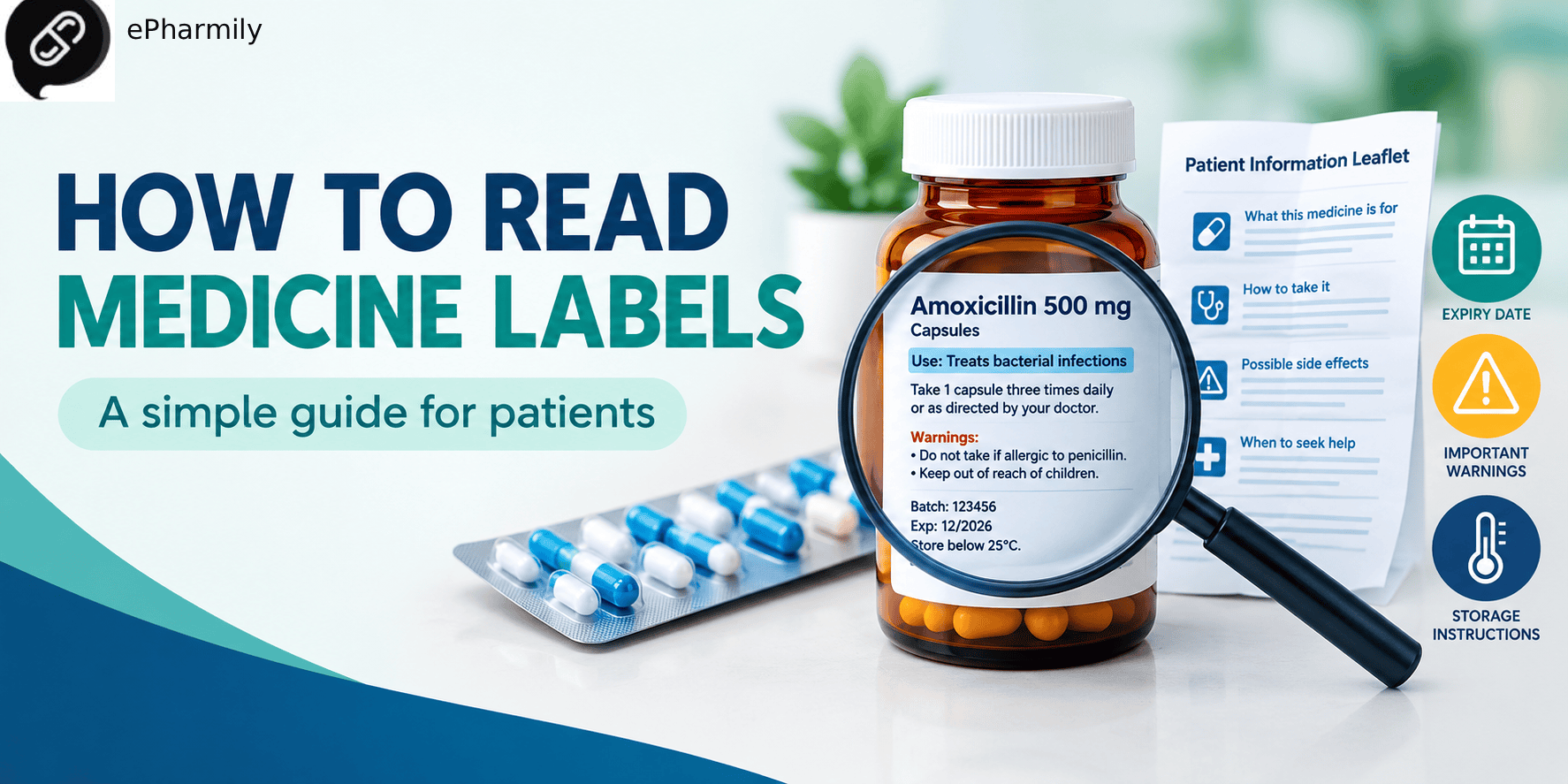
How to Read Medicine Labels: A Simple Guide for Patients
Introduction
Have you ever bought a medicine and wondered what the information printed on its packaging actually means? You are not alone. Medicine labels contain important details that help patients understand what they are taking, how to use it correctly, and what precautions to follow.
However, overlooking a small instruction can lead to medication errors, incorrect dosing, or avoidable side effects. Learning how to read medicine labels is therefore an important step towards using medicines safely.
Whether you are taking prescription medication or buying an over-the-counter medicine, understanding the label can help you make informed decisions about your health. The U.S. Food and Drug Administration (FDA) and Nigeria's National Agency for Food and Drug Administration and Control (NAFDAC) emphasise the importance of clear medicine labelling and safety information.
1. Check the Name of the Medicine
The first thing to look for is the medicine's name. Most medicines have a brand name, a generic name, or both.
-
Brand name: The name given to a medicine by its manufacturer.
-
Generic name: The name of the active ingredient responsible for the medicine's effect.
For example, a medicine may be sold under a particular brand name while containing paracetamol as its active ingredient.
Why does this matter? Different products may contain the same active ingredient. Taking them together without checking their ingredients could result in accidentally taking too much of that substance.
Tip: Always check the active ingredients, especially when using multiple medicines for different symptoms.
2. Understand the Strength of the Medicine
The strength tells you how much active ingredient is present in a tablet, capsule, measured volume, or other dosage unit.
It may be written in measurements such as:
-
Milligrams (mg)
-
Micrograms (mcg or µ
-
Milligrams per millilitre (mg/mL)
-
International units (IU), where applicableFor example, a label stating 500 mg identifies the amount of active ingredient in the specified dosage unit. It does not automatically mean that everyone should take 500 mg at a time.
The correct dose depends on the particular medicine, the patient's age and health circumstances, and the instructions provided by an appropriate healthcare professional.
Remember: Medicines with similar names may come in different strengths. Always check the strength before taking a dose.
3. Read the Dosage Instructions Carefully
Dosage instructions explain how much medicine to take, how often to take it, and sometimes how long to continue using it.
You may see instructions such as:
-
Once daily: Take it once a day.
-
Twice daily: Take it two times a day.
-
Three times daily: Take it three times a day.
-
As needed: Take it only when necessary, within the prescribed limits.
-
Complete the prescribed course: Follow the healthcare professional's instructions for the duration of treatment.
These phrases are general explanations, not instructions to change your own medication schedule. The precise timing and maximum dose depend on the medicine.
Do not assume that taking a medicine more frequently will make it work faster. Taking more than the recommended amount can cause harm.
For liquid medicines, use the measuring device supplied or recommended for the product. A kitchen teaspoon is not a reliable substitute for a proper medicine-measuring device.
If the dosage instructions are unclear, ask a pharmacist or prescribing healthcare professional before taking the medicine.
4. Know the Route of Administration
The route of administration tells you how a medicine should enter or be applied to the body.
Common examples include:
-
Oral: Taken by mouth.
-
Topical: Applied to the skin.
-
Ophthalmic: Used in the eyes.
-
Otic: Used in the ears.
-
Inhalation: Breathed into the lungs.
-
Injection: Administered by injection using the appropriate method.
This information is important because medicines designed for one route may be unsafe when used another way.
For example, an eye preparation should not automatically be assumed suitable for the ears, and a product intended for external use should not be swallowed.
Safety reminder: Never change how a medicine is administered without checking with a pharmacist or other qualified healthcare professional.
5. Pay Attention to Warnings and Precaution
Warnings explain circumstances in which a medicine may be unsuitable or require additional care.
Depending on the medicine, the label may warn about:
-
Possible side effects, including drowsiness.
-
Allergies to active or inactive ingredients.
-
Interactions with other medicines, supplements, food, or alcohol.
-
Use during pregnancy or breastfeeding.
-
Medical conditions that may affect safe use.
-
Restrictions on driving or operating machinery.
For example, a medicine that causes drowsiness may affect your ability to drive safely.
Do not ignore warning statements simply because you have used the medicine before. Your health circumstances and other medicines may have changed.
If you have allergies, are pregnant or breastfeeding, have an existing medical condition, or take several medicines, consult a healthcare professional when you are unsure whether a product is appropriate for you.
6. Check the Expiry Date
The expiry date indicates the period up to which the manufacturer expects the medicine to meet its specified quality standards when stored under the stated conditions.
Look for markings such as:
-
EXP: Expiry date.
-
MFG: Manufacturing date.
-
Batch No. or Lot No.: A code used to identify a particular production batch.
For example, if a product's expiry date is marked EXP 10/2027, it generally means the product expires at the end of October 2027, subject to the product's labelling conventions.
Never use a medicine beyond its expiry date. Some products may also have a shorter usable period after opening, reconstitution, or dilution. This is particularly important for certain liquids and other preparations.
If the date is missing, unreadable, or unclear, ask a pharmacist rather than guessing.
7. Understand Storage Instructions
Storage instructions help preserve a medicine's quality, stability, and effectiveness.
A label may instruct you to:
-
Store below a specified temperature.
-
Refrigerate the medicine.
-
Protect it from light.
-
Keep it in a dry place.
-
Keep the container tightly closed.
-
Keep it out of the reach and sight of children.
Not every medicine should be refrigerated. Some may be damaged by excessive cold, heat, moisture, or sunlight.
For example, storing tablets in a damp bathroom may expose them to moisture that affects their quality.
Follow the specific instructions printed on the packaging or supplied leaflet. If a medicine has been stored incorrectly, ask a pharmacist whether it remains suitable for use.
8. Look for the Active Ingredients and Other Ingredients
The active ingredient produces the intended therapeutic effect. Other ingredients, sometimes called inactive ingredients or excipients, help with the medicine's formulation, stability, appearance, or taste.
Some people may need to avoid particular ingredients because of allergies, intolerances, or other health considerations.
Checking the ingredient list is especially important when:
-
You have a known medicine allergy.
-
You use multiple cold, flu, or pain-relief products.
-
You have previously experienced a reaction to a medicine.
-
You need to avoid a particular ingredient for medical reasons.
If you are uncertain whether a product contains an ingredient that could affect you, ask a pharmacist to review the label.
9. Check the Manufacturer and NAFDAC Registration Number
In Nigeria, consumers should pay attention to the manufacturer's details and the NAFDAC registration number when checking medicine packaging.
Look for:
-
The manufacturer's name and address.
-
The NAFDAC registration number, where applicable.
-
The batch or lot number.
-
The manufacturing and expiry date
-
Intact seal and packaging that does not appear tampered with.
These details help with product identification and traceability. However, a registration number alone does not prove that a particular pack is genuine.
If the packaging appears suspicious, important information is missing, the seal is broken, or the product looks unusual, do not use it until the concern has been checked. Purchase medicines from legitimate, appropriately licensed sources and report suspected substandard or falsified products to NAFDAC.
10. Read the Patient Information Leaflet
Some medicine information cannot fit on the label alone. A patient information leaflet (PIL), sometimes called the package leaflet, provides further details about the medicine's use and precautions.
Depending on the product, it may explain:
-
What the medicine is used for.
-
Who should not use it.
-
How to take or administer it.
-
Possible side effects.
-
Interactions and precautions.
-
Storage and disposal instructions.
Do not discard the leaflet before reviewing the relevant information. If the label and leaflet seem inconsistent, or the instructions differ from those given on your prescription, consult your pharmacist or prescriber before proceeding.
Common Mistakes to Avoid When Reading Medicine Labels
Even when medicine packaging is familiar, it is easy to overlook important information. Avoid these common mistakes:
Even when medicine packaging is familiar, it is easy to overlook important information. Avoid these common mistakes:
-
Checking only the brand name: Always check the active ingredient and strength.
-
Guessing the dose: Follow the product's appropriate instructions or your prescription.
-
Ignoring warnings: Read precautions even if you have used a similar product before.
-
Using expired medicines: Check the expiry date and any shorter period of use after opening.
-
Assuming all medicines are stored alike: Follow the specific storage instructions.
-
Combining products without checking ingredients: Some medicines contain overlapping active ingredients.
-
Ignoring suspicious packaging: Check the seal, registration details, and product information.
When Should You Ask a Pharmacist for Help?
Ask a pharmacist or another appropriate healthcare professional if:
-
You cannot understand the dosage instructions.
-
You are unsure whether two medicines can be taken together.
-
You notice conflicting information on the label and prescription.
-
You have an allergy or are concerned about side effects.
-
You are unsure how to store a medicine or how long it remains usable after opening.
-
The packaging appears damaged, suspicious, or incomplete.
Seeking clarification before taking a medicine is safer than guessing.
-
-
-
-
-
-
-
-
-
References
- National Agency for Food and Drug Administration and Control (NAFDAC). Guidelines for Registration of Drug Products Made in Nigeria: Human and Veterinary Drug Products.
- U.S. Food and Drug Administration (FDA). The Over-the-Counter Drug Facts Label.
- U.S. Food and Drug Administration (FDA). Use Medicines Wisely.
Join

Responsive (side bar)2
Categories
Read More
Medication errors remain one of the most serious yet preventable threats in modern healthcare. Whether in hospitals, pharmacies, or at home, these mistakes can lead to treatment failure, adverse drug reactions, or even death. According to the World Health Organization, medication-related harm affects 1 in every 30 patients globally, with a significant proportion being severe or...
Pharmacy is a critical profession in Nigeria’s healthcare system, bridging the gap between medicine and patient care. As the demand for highly skilled pharmacists grows, so does the importance of quality pharmacy education. Nigeria boasts several universities with accredited pharmacy faculties, each contributing significantly to the training of competent pharmacists who excel both...

Hey there, future pharmacists! Let’s be real—pharmacy school is no walk in the park. Between endless lectures, mountains of notes, and the constant pressure to exams, it’s easy to feel like your personal life has taken a backseat. But here’s the thing: you don’t have to sacrifice your well-being to succeed in pharmacy school. Balancing pharmacy school and...

As a seasoned pharmacist with years of experience hiring and mentoring pharmacy professionals, I’ve seen firsthand what sets successful candidates apart during pharmacy job interview. Whether you’re a recent pharmacy graduate or an experienced professional looking to advance your career, preparing for a pharmacy interview requires more than just brushing up on your knowledge of...

Please note, that these questions, are rough collections of the real past pep exam questions and answers put together by pharmacists, that sat for the 2024 pep examination, held in all accredited centers in Nigeria. Full questions and answers are on the Pharmacy Quiz App. What is PEP Exam? PEP stands for “ Pre-registration examination for Pharmacists” in Nigeria. This examination...