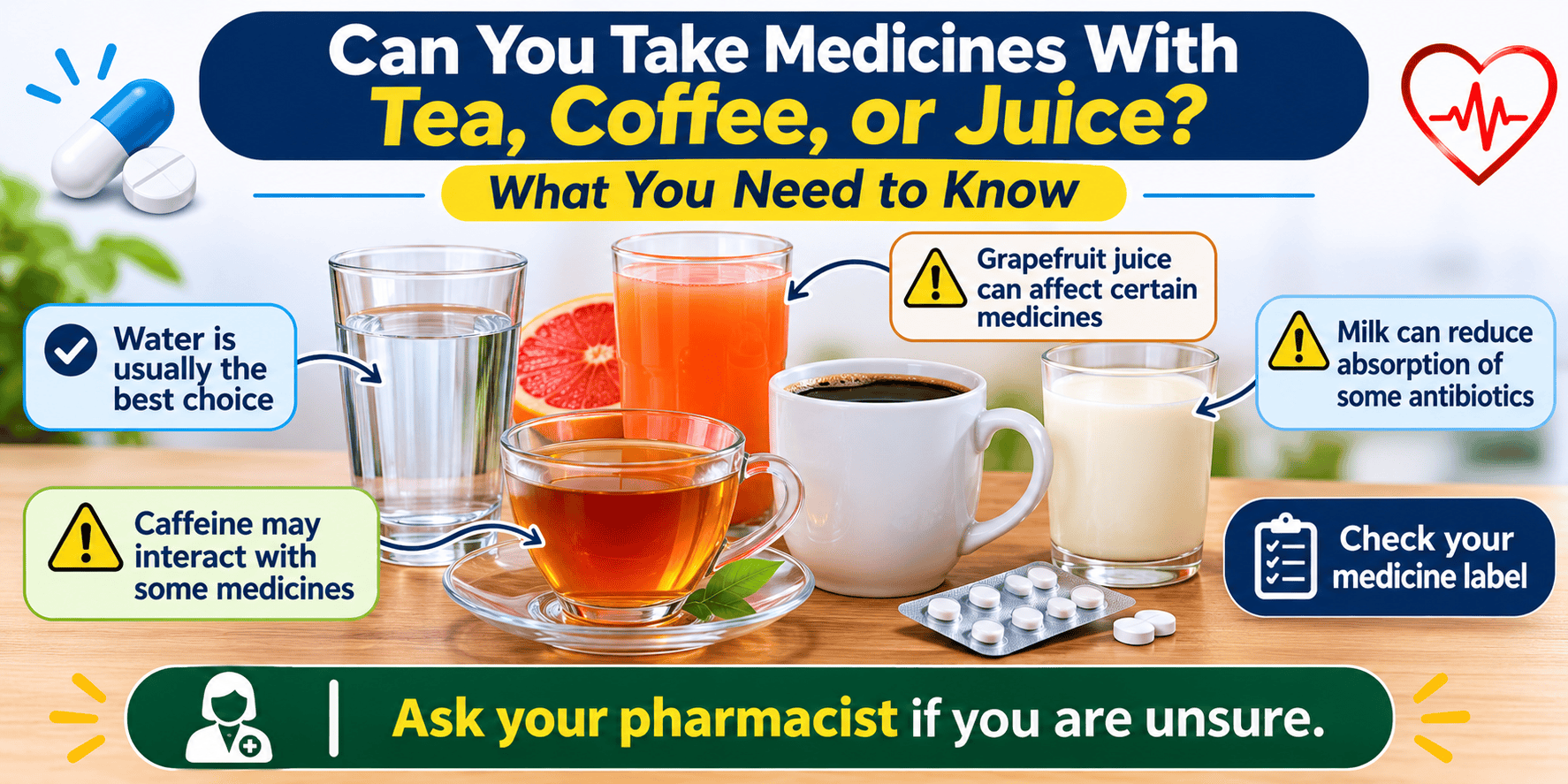
Can You Take Medicines With Tea, Coffee or Juice? A Guide to Medicine and Drink Interactions.

Introduction
Many people take their medicines with whatever drink is readily available. For some, it may be a cup of tea in the morning, coffee before work, a glass of juice at breakfast or even milk before bedtime.
Although this may seem harmless, certain drinks can affect how medicines work in the body. Some can reduce the amount of medicine absorbed, while others may increase the amount that enters the bloodstream and raise the risk of side effects.
These reactions are known as food–drug or beverage–drug interactions.
Not every drink interacts with every medicine, and the effect depends on the specific medicine involved. However, knowing which combinations to be careful with can help you avoid unnecessary health risks.
In this article, we explain how common drinks interact with medicines and what you should know before taking your next dose.
1. Why Can Drinks Affect How Medicines Work?
When you swallow a medicine, it must be absorbed and processed by the body before it can produce its intended effect.
Some drinks contain substances that can interfere with this process. Depending on the medicine, a drink may:
-
Reduce how much of the medicine enters the bloodstream.
-
Increase the amount of medicine in the body.
-
Delay or change how quickly the medicine is absorbed.
-
Increase the likelihood of unwanted side effects.
This means that a medicine may not work as expected or may produce stronger effects than intended.
2. Can You Take Medicines With Water?💦
Water is generally the safest and preferred drink for taking most oral medicines.
It helps you swallow tablets and capsules and does not contain the same potentially interacting substances found in some other beverages.
However, water is not a substitute for following the instructions on your medicine label.
Some medicines must be taken with food, while others need to be taken on an empty stomach. Certain medicines also require specific timing or instructions.
Always follow the directions provided by your healthcare professional or the medicine's patient information leaflet.
3. Can You Take Medicines With Tea?
Tea is a common everyday drink, but it may not be suitable for taking every medicine.
Some teas contain caffeine, while others contain plant compounds that may affect particular medicines.
For example:
-
Caffeinated tea: Caffeine may interact with certain medicines, potentially increasing effects such as restlessness, nervousness or a rapid heartbeat.
-
Green tea: It may interact with some medicines, including certain blood-thinning treatments, depending on the product and amount consumed.
Herbal teas: Ingredients in herbal teas can interact with prescription medicines. Natural ingredients are not automatically safe to combine with medicines.
If you regularly drink herbal or green tea and take prescription medication, ask your pharmacist whether there are any specific interactions to consider.
4. Can You Take Medicines With Coffee?☕
Coffee contains caffeine, a stimulant that affects the central nervous system.
Although moderate coffee consumption is acceptable for many people, caffeine can interact with certain medicines.
For example:
-
Some medicines may slow down how quickly the body breaks down caffeine, causing it to remain in the body longer.
-
Certain stimulant medicines may produce stronger effects when combined with large amounts of caffeine.
-
Combining caffeine with some medicines may increase restlessness, anxiety, sleep difficulties or a fast heartbeat.
Coffee may also be unsuitable for certain medicines because of their specific absorption instructions.
If your medicine label says to avoid caffeine or limit coffee consumption, follow that advice.
5. Can You Take Medicines With Fruit Juice?
Not all fruit juices affect medicines in the same way. Some are safe with many medicines, while others can cause important interactions.
Grapefruit juice🍇
Grapefruit juice is one of the best-known examples of a drink that interacts with certain medicines.
It can affect enzymes and transport proteins involved in how the body processes or absorbs some medicines.
This may cause too much or too little of a medicine to enter the bloodstream.
Some medicines that may interact with grapefruit include:
-
Certain cholesterol-lowering medicines, such as simvastatin and atorvastatin.
-
Some medicines used to treat high blood pressure.
-
Certain medicines used to manage abnormal heart rhythms.
The interaction does not affect every medicine in these categories. The risk depends on the particular medicine.
If your medicine has a grapefruit warning, do not assume that separating the juice and medicine by a few hours will make the combination safe. Ask your pharmacist for advice.
Orange and apple juice🍊🍏
Some fruit juices can interfere with the absorption of particular medicines.
For example, apple and orange juice can reduce the absorption of fexofenadine, a medicine used to relieve allergy symptoms.
This may make the medicine less effective.
If you take fexofenadine, follow the product instructions about taking it with water and avoiding fruit juice.
6. What About Taking Medicines With Milk?🥛
Milk contains calcium and other minerals that can affect the absorption of certain medicines.
For example, calcium can bind to some antibiotics, including tetracyclines and fluoroquinolones, reducing the amount of medicine absorbed by the body.
This may affect how well the treatment works.
However, not all antibiotics interact with milk, and the instructions vary between medicines.
If you are prescribed an antibiotic, check whether it should be taken with food, milk or on an empty stomach. Do not assume that all antibiotics have the same instructions.
7. What About Alcohol and Medicines?🍺
Alcohol can interact with several types of medicines and may increase the risk of unwanted effects.
Depending on the medicine, combining alcohol with treatment may cause:
-
Increased drowsiness and dizziness.
-
Poor coordination and slower reactions.
-
Increased risk of falls or accidents.
-
Stomach irritation or bleeding with certain medicines.
-
Increased strain on the liver with some medicines.
Alcohol can be particularly dangerous when combined with medicines that cause sedation, including some sleeping tablets, anxiety medicines and opioid painkillers.
If your medicine label advises you to avoid alcohol, take that warning seriously.
8. How Can You Avoid Drink–Medicine Interactions?
You do not have to avoid every drink while taking medication. The important thing is knowing which combinations are unsuitable for the specific medicine you use.
Here are some practical ways to reduce the risk:
-
Use water unless instructed otherwise. Water is generally the best choice for swallowing tablets and capsules.
-
Read the medicine label📃. Check whether your medicine should be taken with food, on an empty stomach or away from particular drinks.
-
Ask your pharmacist👨⚕️. If you are unsure whether tea, coffee, milk or juice is suitable, seek professional advice.
-
Mention your regular drinks. Tell your healthcare professional about your usual tea, coffee, juice and alcohol consumption.
- Do not assume all medicines have the same instructions. Different medicines can have very different interaction risk.
-
Do not change your medication routine yourself. Avoid skipping doses, changing the timing or stopping treatment because of a possible interaction without professional guidance.
9. When Should You Speak to a Pharmacist or Doctor?👨⚕️
Speak to a pharmacist or doctor if:
-
You are unsure which drink is safe with your medicine.
-
You regularly consume grapefruit juice or herbal teas while taking prescription medication.
-
Your medicine label contains food or drink warnings you do not understand.
-
You experience unusual symptoms after taking medicine with a particular drink.
-
You are taking several medicines and are concerned about possible interactions.
If you experience a severe reaction, such as difficulty breathing, swelling of the face or throat, fainting or severe chest pain, seek emergency medical attention immediately.
Taking medicines with tea, coffee, juice or milk may seem like a small everyday decision, but certain drinks can affect how medicines are absorbed and processed in the body.
Grapefruit juice, caffeine-containing drinks, milk and alcohol can interact with specific medicines, potentially reducing their effectiveness or increasing the risk of side effects.
The safest general practice is to take medicines with water unless the instructions say otherwise. Always read the medicine label and ask a pharmacist if you are unsure.
Remember: The right medicine matters, but taking it correctly matters too.
-
-
Источники